 Ultimate guide
How to Plan Event Catering Menu: Complete Guide
Table of Contents
- Define Your Event Type and Guest Count
- Choose Your Catering Service Style and Menu Format
- How Much Food to Serve Per Person at an Event
- Build a Balanced Catering Menu for Small Groups
- Account for Dietary Restrictions and Food Allergies
- Create Your Catering Menu Template and Cost Breakdown
- Budget-Friendly Catering Ideas Without Sacrificing Quality
- Food Safety, Production Timeline, and Event-Day Logistics
- Frequently Asked Questions
Last Updated: October 11, 2026
Define Your Event Type and Guest Count
The foundation of any successful plan event catering menu starts with understanding exactly what you're planning. Are you hosting an intimate dinner for six, a casual backyard gathering, or a formal corporate lunch? The event type determines everything that follows: the formality of your food, the service style, and ultimately, your budget.
Guest count is equally critical. A catering menu for small groups of 10-15 people requires a completely different approach than planning for 50 or 100. With smaller gatherings, you have flexibility to offer more variety and personalization. With larger events, you need to simplify your selections to what can be prepared and served efficiently.
Start by asking yourself these questions: What's the purpose of this event? Is it a celebration, a business meeting, or a casual social gathering? How long will guests be there? Will they be standing, seated, or mingling? What's the time of day? These details shape whether you need a full meal, light appetizers, or something in between.
Choose Your Catering Service Style and Menu Format
Your service style determines how food is presented and consumed, which directly impacts both the guest experience and your logistics. The three primary service styles are plated service, buffet, and food stations.
Plated service works best for formal dinners or smaller, seated events. Each guest receives a prepared plate with predetermined portions. This style looks polished and feels elevated, but requires more staff or preparation time.
Buffet service suits casual gatherings where guests serve themselves. It works well for medium-sized groups and creates a relaxed atmosphere. The main drawback is that some guests may take too much while others take too little, making quantity planning tricky.
Food stations offer a middle ground. Guests move through different stations (carving station, pasta station, taco bar) and customize their plates. This style feels interactive and accommodates dietary preferences naturally. However, it requires more space and coordination than a simple buffet.
Each style affects your menu planning differently. With plated service, you control every element. With buffet or stations, you need to ensure each dish stands alone and photographs well.
How Much Food to Serve Per Person at an Event
Getting portion sizes right prevents both waste and hungry guests. The amount you serve per person depends on the event type, duration, and whether you're offering a full meal or light refreshments.
For a lunch or dinner event with a main course, plan on 1.5 to 2 pounds of food per person total (including protein, sides, and bread). This breaks down roughly to 5-6 ounces of protein, plus substantial sides.
If you're serving a buffet with multiple protein options, assume guests will take 4-5 ounces of protein rather than the full 5-6 ounces they'd get on a plated plate. They'll balance it with more sides and bread.
Side dishes and starches should make up about one-third of the total meal by weight. If you're serving two sides, each should provide about 3-4 ounces per person. Dessert portions are typically smaller: 2-3 ounces per person, or one dessert item per guest.
These are guidelines, not absolutes. Consider your specific audience. A business lunch crowd typically eats lighter portions than a celebration dinner. Families with young children eat less than groups of young adults.
Build a Balanced Catering Menu for Small Groups
A balanced catering menu offers variety across proteins, vegetables, and flavors while remaining manageable to execute. For a small group event, you don't need five protein options, three solid choices create plenty of variety without overwhelming your preparation.
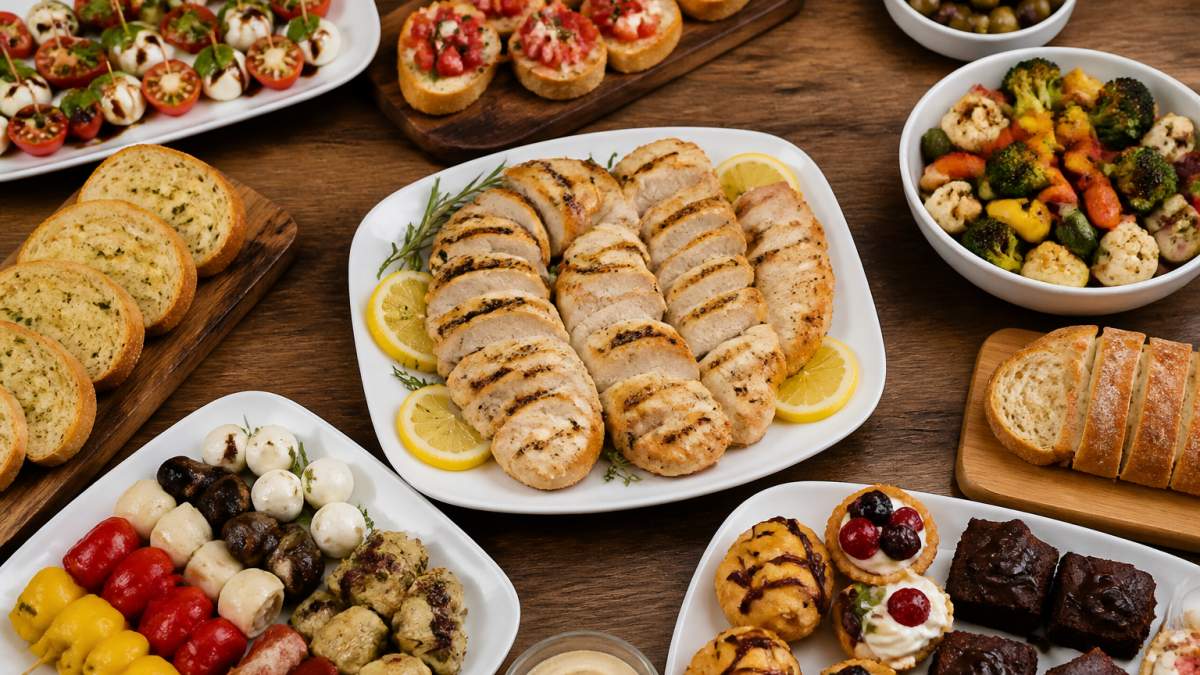
Structure your menu around one primary protein, one secondary option, and one vegetarian choice.
Include at least two sides that complement your proteins. A starch (roasted potatoes, rice pilaf, or artisan bread) and a vegetable dish (roasted seasonal vegetables, a fresh salad, or a composed side) give guests balance and satiety.
Appetizers should preview your menu's flavor profile. If your main course is Mediterranean, serve hummus, olives, and cured meats. If you're going Italian, offer bruschetta and fresh mozzarella.
Dessert should reflect the formality of your event. A casual gathering works with simple cookies or brownies. A more formal event calls for something more refined.
When planning a catering menu for small groups, aim for balance across temperatures, textures, and flavors. Include at least one hot dish, one cold item, something creamy, and something with crunch.
Account for Dietary Restrictions and Food Allergies
Dietary restrictions are no longer the exception, they're the norm. Always ask guests about allergies and dietary preferences when you're planning your catering menu. The most common restrictions you'll encounter are gluten-free, vegetarian, vegan, dairy-free, and nut allergies.
Build your menu with these restrictions in mind from the start, rather than treating them as afterthoughts. Choose a main protein that's naturally compliant with most diets (grilled chicken or fish works better than something breaded or heavily sauced).
Create clear labeling for every dish at your event. Include the main ingredients and note common allergens: nuts, dairy, gluten, soy, shellfish, and eggs. This helps guests make informed choices and protects those with severe allergies from cross-contact.
Cross-contact is a real concern, especially for guests with celiac disease or severe allergies (Dining and Social Eating). Use separate serving utensils for each dish. If you're preparing food yourself, use separate cutting boards and preparation surfaces for allergen-free items.
When you're planning your event catering menu, consider offering one protein-forward vegetarian option that feels substantial, not like an afterthought.
Create Your Catering Menu Template and Cost Breakdown
A written template keeps you organized and makes it easy to adjust quantities or swap items. Start with the basics: event date, guest count, service style, and any dietary restrictions. Then list your selections by course.
TO SEE OUR DAILY MENU CLICK HERE!(CONCORD COMMONS LOCATION ONLY) →
Sample Template Structure:
| Component | Selection | Quantity | Notes |
|---|---|---|---|
| Protein Option 1 | Herb-roasted chicken | 1.5 lbs per person | Primary choice |
| Protein Option 2 | Grilled salmon | 0.5 lbs per person | Secondary option |
| Vegetarian | Roasted vegetable medley | 0.5 lbs per person | Gluten-free friendly |
| Starch | Roasted potatoes | 0.5 lbs per person | Dairy-free |
| Vegetable | Fresh garden salad | 2 cups per person | Dressing on side |
| Bread | Artisan rolls | 2 per person | Gluten-free option available |
| Dessert | Chocolate mousse | 3 oz per person | Dairy-free option available |
Breaking down costs helps you stay within budget. List each item with its per-unit cost and total cost for your guest count. This visibility shows you where your money is going and where you might make adjustments. If appetizers are consuming 30% of your budget but guests barely touch them, that's useful information for future events.
When you're planning your event catering menu with a cost breakdown, identify your fixed costs (staff, rentals, delivery) separately from your food costs. This helps you see where you have flexibility. Food costs are often easier to adjust than fixed expenses.
Budget-Friendly Catering Ideas Without Sacrificing Quality
Serving excellent food doesn't require an unlimited budget. The key is strategic choices about what to splurge on and where to save.
Focus your spending on one or two standout elements. If you're serving grilled salmon, make it excellent salmon, don't economize there. Pair it with simpler sides that are still delicious.
Seasonal ingredients cost less and taste better.
Consider dishes that are naturally economical but feel special. Braised dishes, grain-based salads, and slow-cooked proteins often cost less than premium cuts while delivering impressive flavor.
Batch cooking and make-ahead preparation reduce labor costs. Dishes that improve with time, braises, marinades, composed salads, can be prepared days in advance.
At Leo's Gourmet Market, we help local hosts and event planners find that balance between quality and cost. Our diverse, daily rotating menu includes options that deliver chef-crafted quality.
Skip expensive plating and presentation if your budget is tight. Family-style service (large platters passed around the table) or casual buffet presentation looks warm and inviting without requiring professional plating.
Food Safety, Production Timeline, and Event-Day Logistics
Food safety isn't negotiable. Improper handling can ruin an event and make guests sick.
When you're planning your event catering menu, build in a realistic production timeline. Most prepared foods need at least 2-3 days of advance notice. Some items, braises, marinades, baked goods, benefit from extra time.
Create a production schedule that maps out what gets prepared when. Day-of tasks should be minimal: reheating, final plating, and setup. Everything else should be done in advance. This reduces stress and ensures quality.
Transport hot foods in insulated containers designed for that purpose. Cold items need ice packs or coolers. Clearly label everything with contents and any allergen information.
Arrive early to set up and do a final quality check. Verify that hot foods are actually hot, cold foods are cold, and everything is clearly labeled.
When you're planning an event catering menu, consider having a contingency item on hand, something simple that can be served if a dish doesn't work out.
Planning a successful event catering menu requires thinking through your guest count, service style, dietary needs, and budget before you settle on a single dish. See our daily menu and catering options to get started planning your next event.
Frequently Asked Questions
How far in advance should you finalize your event catering menu?
Finalize your catering menu 2-3 weeks before the event for custom options, or 1 week for standard menus. This timeline lets your caterer confirm ingredient availability, handle dietary requests accurately, and prepare production schedules. Last-minute changes are possible but may limit menu flexibility or incur rush fees. For large events over 50 guests, plan 4 weeks ahead to secure your preferred service style and menu variety.
What should you consider when choosing food for an event?
Consider event type (formal dinner, casual gathering, corporate lunch), guest count and demographics, venue capabilities, budget constraints, dietary restrictions, and your audience's cuisine preferences. Balance your menu with protein options, side dishes, appetizers, and desserts to ensure variety. Account for serving style (plated, buffet, or stations) and timing, afternoon events may need lighter fare than evening meals. Test dishes beforehand if possible to confirm quality and presentation.
How do you accommodate dietary restrictions in a catering menu?
Ask guests about dietary restrictions and allergies when confirming attendance. Offer clear alternative menu options for common needs like vegetarian, gluten-free, and dairy-free. Label all dishes with ingredient descriptions and allergen information so guests can identify safe choices. Work with your caterer to prevent cross-contact during food preparation and service. Provide at least one satisfying main course alternative per restriction group so no guest feels limited.
How many menu options should a catered event offer?
For small groups under 25 guests, offer 2-3 main course options plus one vegetarian choice. For 25-75 guests, provide 3-4 mains with 1-2 vegetarian alternatives. Large events over 75 guests benefit from 4-5 main options to accommodate diverse preferences. Include 2-3 appetizer selections and multiple side dishes to add variety without overwhelming your caterer. More options increase food waste and costs, so balance choice with practicality.
What is the cheapest way to cater for 50 people?
Choose a buffet or food station service style rather than plated service to reduce labor costs. Select 2-3 main courses with high-yield sides like rice, pasta, or roasted vegetables. Use seasonal ingredients and proteins that are less expensive (chicken over beef). Order from local caterers or markets offering chef-crafted meals. Limit appetizers and desserts, or ask guests to contribute a side dish for potluck-style events.
How do you plan a catering menu for an event?
Start by defining your event type, guest count, budget, and service style. Identify dietary restrictions early. Select a balanced menu with appetizers, main courses, sides, and desserts that match your audience's preferences. Calculate portion sizes based on event duration and meal type. Get quotes from caterers and finalize your menu 2-3 weeks ahead. Confirm ingredient descriptions, allergen labels, and heating instructions if ordering prepared meals.
How much should you budget for catering per person?
Budget varies by service style and location. Buffet service typically costs less per person than plated dinner. Appetizer-only events run lower than full meals. Local caterers offering chef-crafted prepared meals. Request detailed quotes that break down costs by dish, labor, and delivery. Factor in gratuity and any service fees. For precise pricing on custom menus, contact your caterer directly for a formal estimate.
How do you prevent food waste and manage sustainability in event catering?
Calculate portions accurately using per-person guidelines for your event type to avoid over-ordering. Choose caterers who source local, seasonal ingredients and minimize packaging. Offer guests the option to take home leftovers in compostable containers. Plan a realistic menu that uses ingredients across multiple dishes to reduce spoilage. Communicate final guest count to your caterer 48 hours before the event so they adjust quantities. Consider donating excess prepared food to local food banks if safe handling allows.